
Why Video Lands When Text Does Not
The Attention Gap in a Crowded Inbox
Cold email reply rates have settled into the low single digits.
Instantly’s analysis of billions of sends puts the platform-wide average at 3.43%, with top performers clearing 10%. Which means roughly nineteen out of twenty cold emails go unanswered.
Your prospect opens an inbox holding eight versions of the same email: a trigger line, a value claim, a soft ask. The structure has stopped carrying information since a carefully researched email and a mail-merged one look identical in the preview pane.
A video thumbnail breaks that pattern for a mechanical reason. It takes up space, it shows a face and it tells the reader that someone spent minutes on them rather than seconds.
Vidyard’s data across its customer base shows webcam video turning up 41% more often in closed deals than in lost ones and reports up to 5x more replies when BDRs lead first touches with video.
What Video Proves That Copy Only Claims
Text makes assertions the buyer has no way to check.
A sentence saying you understand how their renewal process breaks down is a claim. Forty seconds of screen recording showing the exact report they rebuild every Monday is evidence and the buyer verifies it in real time by watching.
A landing page describing the product as simple asks for trust and a short clip of someone finishing the task in three clicks removes the need for it.
Video carries the two things text strips out: tone and pace.
A buyer watching sixty seconds of a founder explaining a tradeoff learns whether that founder understands the problem and forms an impression of the company that no case study PDF delivers.
That impression makes a later cold email feel like a follow-up instead of an intrusion.
Sales Demo Video: The 1-to-1 Asset That Starts Conversations
Where the Video Sits in the Sequence
Video works best as a deliberate escalation, not a default first touch.
For tier-one accounts where the deal size justifies the effort, lead with it. For everyone else, put it at step two or step three after a plain-text email has established who you are and what you want.
The prospect who ignored the first email now sees a face attached to a name they half recognize and the reply rate on that second touch tends to carry the whole sequence.
Video earns a second placement after a meeting is booked. Vidyard’s teams report no-show rates dropping by up to a third when a short confirmation clip follows the calendar invite, which turns a diary entry into a commitment.
The Prospecting Video: 45 to 90 Seconds, Built Around One Insight
Keep the first prospecting video to somewhere between forty-five and ninety seconds and build it around a single observation.
Say the prospect’s name in the first three seconds, then say the specific thing you noticed: a job posting, a product launch, a line from a podcast they appeared on. Follow with one insight about what that thing usually creates as a problem, then ask a single question and give a single next step.
The discipline is subtraction. One insight, one question, one ask. Anything that would work in an email sent to fifty companies belongs in the email, not the video.
The Async Demo: Replacing the First Call, Not the Deal
The async demo runs three to seven minutes and does the work of a discovery call that should never have been scheduled.
Screen share, walk through the two or three moments in the product that map to what this prospect actually does and stop. Send it before the call so the meeting starts at question four instead of question one, or send it in place of a call the prospect has been dodging for two weeks.
Treat the async demo as a way to compress the front half of the cycle. Pricing, security review and negotiation still need a live call, since those turns depend on reading the room.
Personalization That Scales: Custom Intro, Reusable Body
The economics of one-to-one video improve when you split the recording in two.
Record a ten to fifteen second intro for each prospect covering their name and the observation, then splice it onto a reusable sixty-second body explaining the offer. The prospect sees a video that opens with their company on screen and your rep spends ninety seconds per account instead of ten minutes.
This structure holds up at roughly thirty to fifty sends a week per rep. Past that, the intros start sounding recited, and the tooling covered further down becomes the better answer.
The Thumbnail, the Subject Line and the Send Mechanics
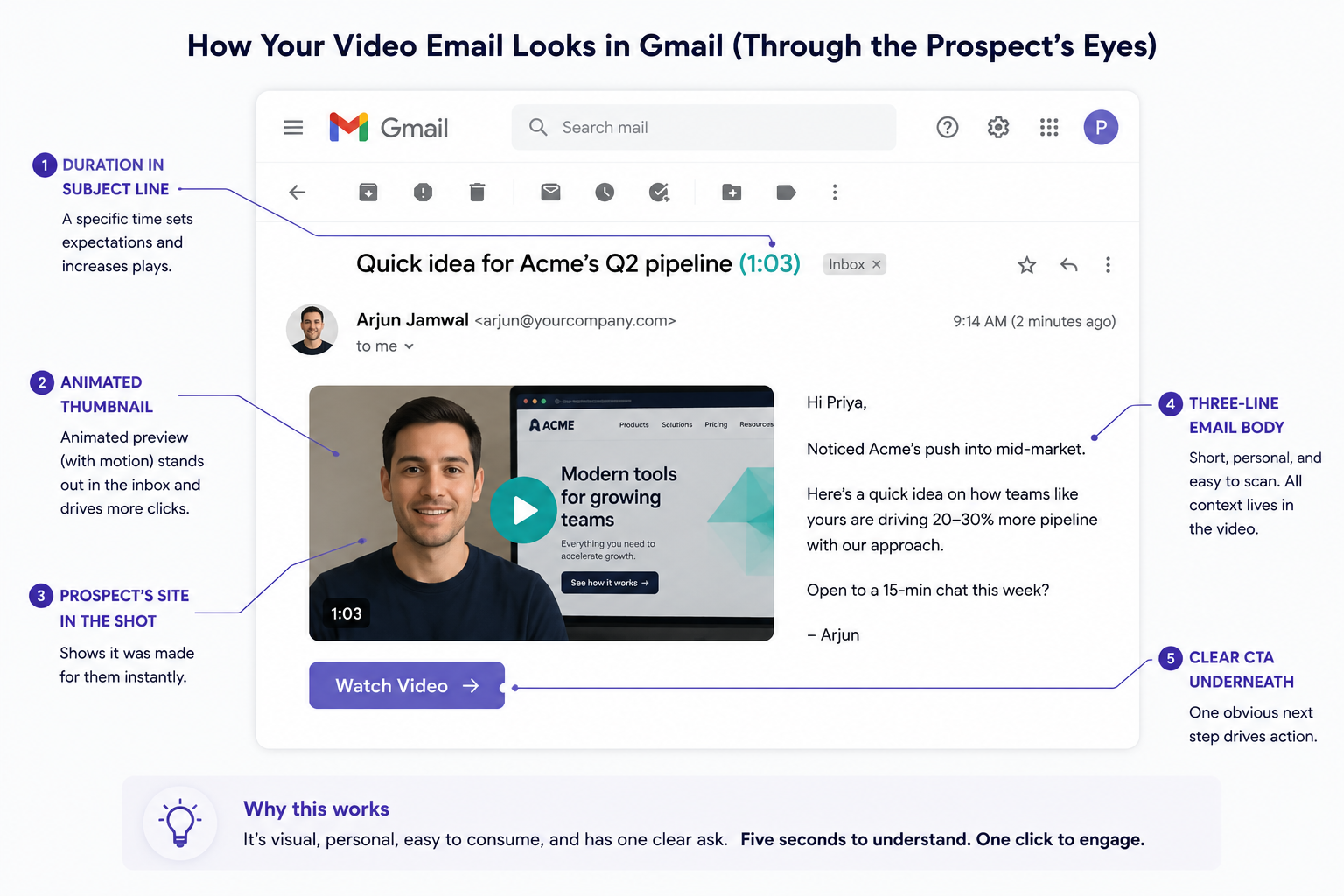
The thumbnail decides whether the video gets played. Use an animated preview instead of a static frame, and put something identifying inside the shot: the prospect’s website open behind you, their name written on a notepad, their logo on your screen. The reader should be able to tell it was made for them without pressing play.
Put the duration in the subject line or the first sentence, since a specific number removes the fear of an open-ended commitment. Host the video and send a linked thumbnail instead of attaching a file, keep the surrounding email to three or four lines and give the video a real ask underneath it.
Common Mistakes: Talking Head Monologues, Product Tours, No Ask
Three failures account for the bulk of wasted recordings. The talking-head monologue delivers a script the prospect could have read faster, with no screen share and no reason for the format to exist.
The product tour walks through nine features when the prospect cares about one, and reads as a demo the rep wanted to give rather than a demo the buyer needed. The third failure is the video that ends warmly with no ask, leaving a prospect who enjoyed sixty seconds and had no idea what to do next.
Over-production belongs on the same list. A slightly rough recording from a real person outperforms a polished corporate cut since polish signals a campaign and roughness signals a person.
Marketing Video: The 1-to-Many Asset That Warms the List
Founder-Led Video and Why It Outperforms Brand Video on LinkedIn
Founder video wins on LinkedIn for a structural reason: the feed distributes people better than it distributes company pages and a face carries a point of view that a brand account cannot credibly hold.
LinkedIn told Reuters that CEO video posts climbed 68% over two years, and Wistia’s survey of more than 900 professionals found LinkedIn is now the primary video channel for eight in ten B2B teams.
The format that works is a founder answering one question they get asked in sales calls, shot on a phone, ninety seconds, no intro sequence. The value sits in the specificity of the opinion, and production quality has close to nothing to do with it.
Short-Form Social Video for Feed Presence and Retargeting Pools
Short-form video does two jobs at once: it builds the recognition that makes outbound land later and it generates a list of people who watched, which becomes a retargeting audience inside LinkedIn’s ad platform.
Wistia’s analysis of over 13 million videos found clips under a minute average a 52% engagement rate, meaning viewers get through roughly half the runtime.
Publish on a schedule, not in bursts. Recognition compounds through repeated exposure and a founder posting weekly for six months builds a warmer list than one who posts fifteen times in March.
Customer Proof: Case Study and Testimonial Video
Testimonial video puts a recognizable job title on camera saying the number out loud. The strongest version is short and specific. One customer, one problem, one measurable result, under ninety seconds, with the number on screen as they say it.
Record the long interview and cut it into pieces. A twenty-minute customer conversation yields a two-minute hero cut for the website, three short clips for social and a handful of thirty-second answers to specific objections that reps can send during live deals.
Product Explainer and Category Education Video
The explainer answers the question a buyer asks before any other: what is this and is it for someone like me. Sixty to ninety seconds, plain language, one clear use case, no feature list. Put it on the homepage and the pricing page where visitors arrive already deciding.
Category education video serves a different buyer, the one who has the problem and lacks a name for it. Those viewers arrive earlier in their thinking and become the retargeting pool outbound converts three months later.
Native Upload, Captions and the First Three Seconds
Upload directly to the platform. Feeds suppress links that send people away, and a native upload gets autoplay, in-feed captions and the watch-time signals the ranking model reads.
Burn captions into the video instead of relying on auto-generated tracks. Design the opening three seconds for a muted screen: start on a face or a piece of text that states the claim, and cut every frame of throat-clearing before it.
How the Two Work Together Across the Funnel
Marketing Video Builds the Recognition That Outbound Cashes In
The case for running both comes out of how buyers actually shop. 6sense’s study of more than 4,000 buyers found the winning vendor was already on the day-one shortlist 95% of the time, that buyers initiate first contact around 80% of the time, and that first contact now happens about 61% of the way through their evaluation.
Those numbers describe a market where the decision is largely formed before a rep speaks. Marketing video is how you get onto the day-one list. Sales video is how you reach the buyers who never raise their hand.
Video Viewers as a Retargeting and Warm-List Signal
Every marketing video produces an audience segment. Someone who watched half a founder post is a different prospect from someone who scrolled past, and both ad platforms and analytics tools expose that distinction. Feed those viewer lists back into the target account list and rank outbound by who has already spent time with your content.
The rep sending a prospecting video to someone who watched two founder posts is running a warm sequence with cold-outbound economics.
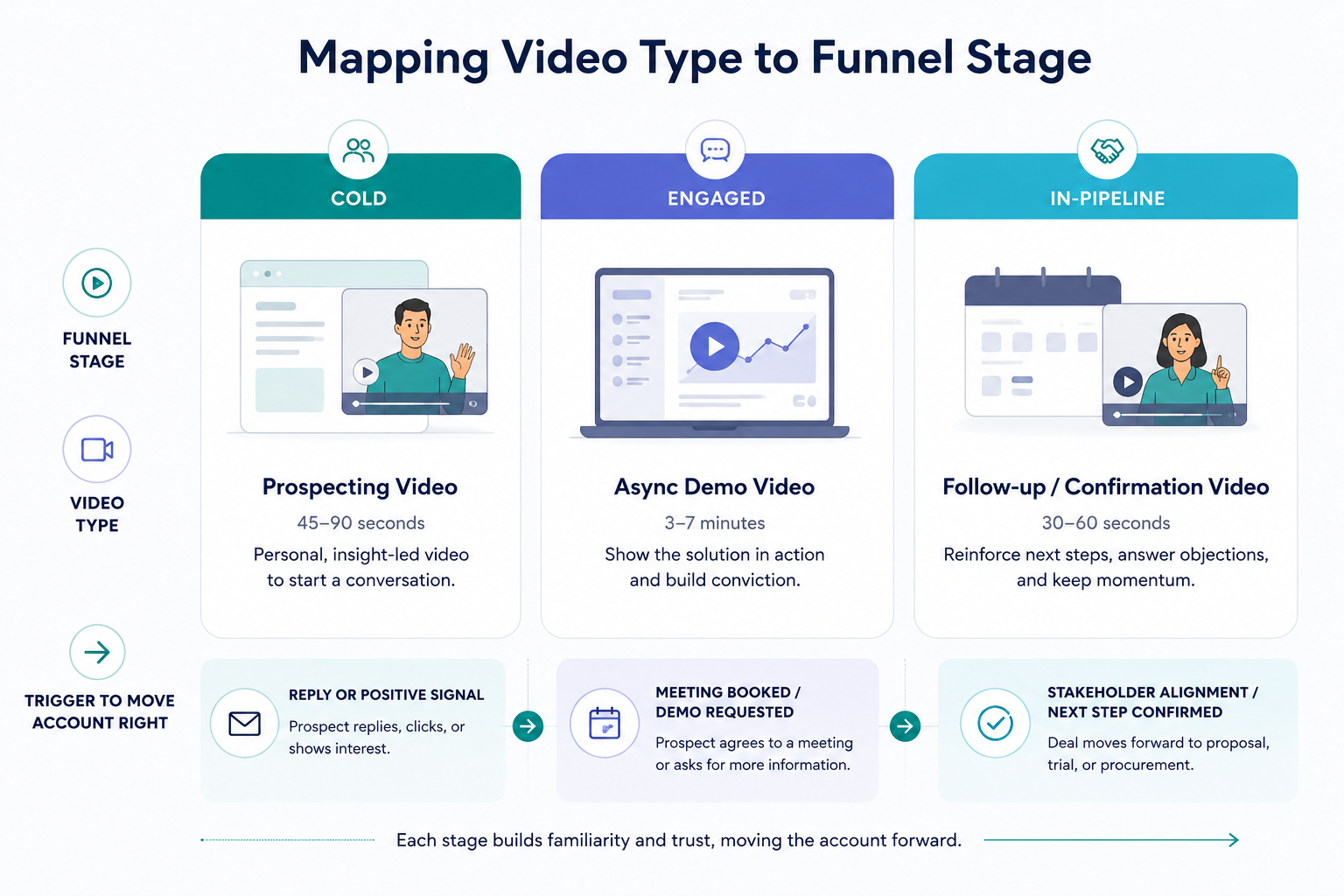
Mapping Video Type to Funnel Stage: Cold, Engaged, In-Pipeline
Cold accounts get one-to-many assets: short-form social, founder video, category education. Engaged accounts, meaning the ones showing watch time or site visits, get the one-to-one prospecting video that names what they engaged with. Accounts in pipeline get async demos, stakeholder-specific recordings for new people who join the buying group, and short recap videos after each call.
The Handoff: What Sales Should Reuse From Marketing Assets
Marketing should hand sales a small, labeled library instead of a folder. Four things earn their place: the sixty-second explainer, three customer clips sorted by industry, a set of thirty-second objection answers and the last webinar recording. Reps then record a ten-second personal intro and forward a marketing asset behind it, which gives the prospect polished substance and a human face in one send.
Video Creation in the Age of AI
The production model that holds up is long-form first, short-form second. Record the thing that has to be long anyway (a webinar, a customer interview, a podcast appearance, etc.) then cut eight to twelve short pieces out of it. One two-hour session feeds a quarter of social content and every clip inherits the credibility of the longer conversation.
AI has moved the cost of personalization, not the cost of good ideas.
Voice cloning, avatar generation and dynamic name insertion let one recording become hundreds of versions that each open with the right company name. The scripts, the observations and the offer still have to be written by someone who understands the buyer.
You can use avatars for volume plays and real recordings for anything late-stage.
A generated video could work for a first touch on a list of 500 depending on who you are targeting. A deal at the pricing stage needs the rep’s actual face, and buyers notice the difference at exactly the moment it costs you money.
What to Measure
Sales Video Metrics
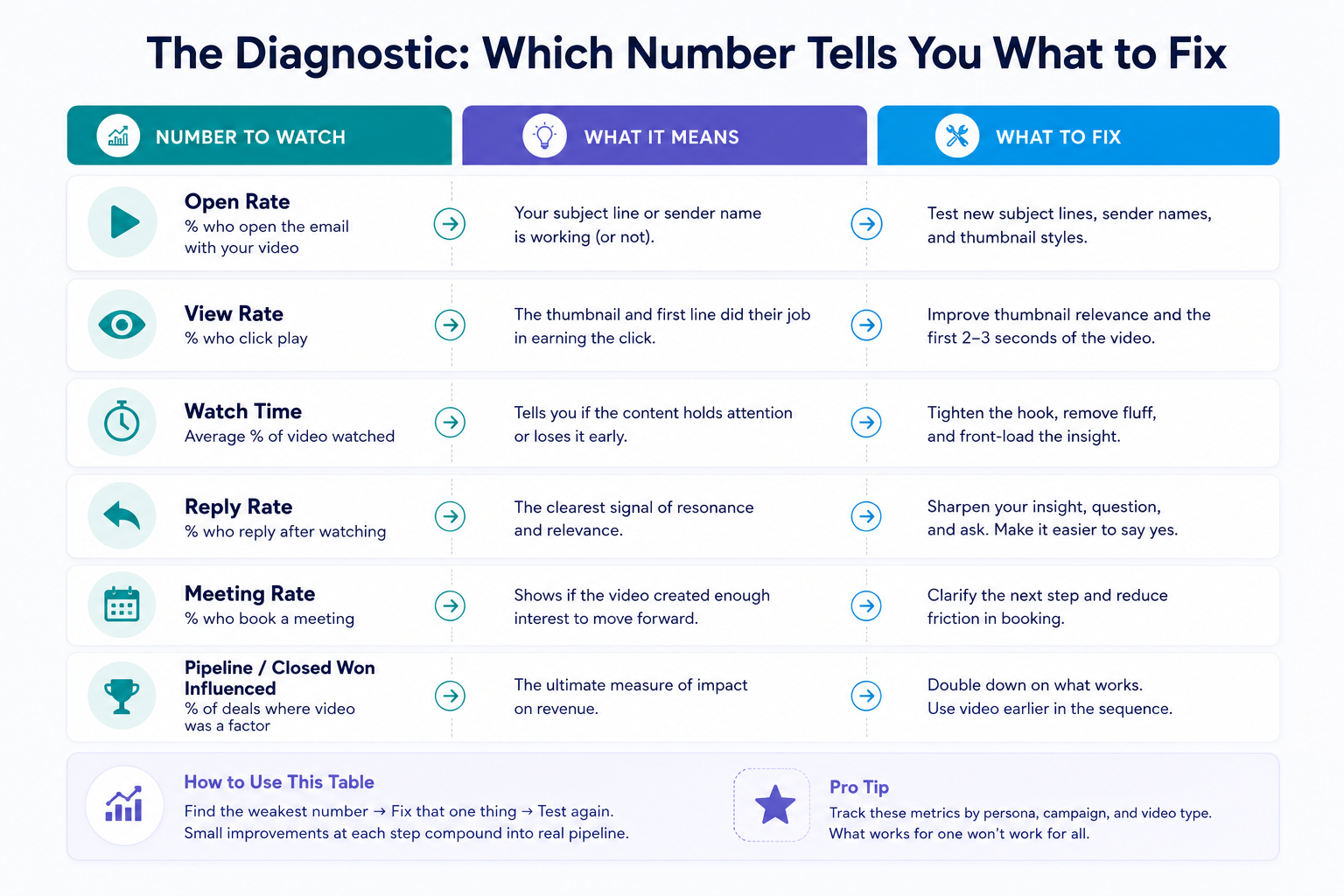
Track four numbers per sequence: open rate on the video email, watch rate against a text-only control, reply rate and meetings booked. The control matters more than the absolute figures, since video only earns its extra minutes if it beats the email you would have sent anyway.
Marketing Video Metrics
Marketing video needs view-through rate, total watch time and audience quality. Audience quality is the one teams skip and the one that decides everything, since ten thousand views from students is worth less than four hundred from your ICP.
The Diagnostic: Which Number Tells You What to Fix
Ready to Add Video to Your Outbound Motion?
Aihiom builds and runs outbound systems for B2B teams end to end. Book a call to see what it would look like for your pipeline.
Book a CallWhere to Start
Pick ten accounts that already match your best customers and record ten prospecting videos over two weeks. Same skeleton each time: name, observation, one insight, one question, one ask, under ninety seconds. Send five with video and five with your standard text email, then compare reply rates. Ten sends will not give you statistical certainty, and it will tell you whether your reps can hold a camera and whether your observations are sharp enough to matter.
Running this properly takes list building, sequencing, deliverability and a rep with time to record. Aihiom builds and runs that motion for B2B teams end to end. Book a call to see what it would look like for your pipeline.